
The best artificial Christmas tree for your home depends first on the space you have, then on how realistic you want the foliage to look and how much setup work you accept. The products below are compared from their listed specifications and documented features rather than hands-on testing, so stated limits and trade-offs remain part of each recommendation.
An artificial tree is a multi-year purchase. Most well-made trees last six to ten seasons, which makes the branch material, the lighting choice, and the storage plan matter more than any single decoration decision. Start with measurements: ceiling height minus roughly one foot for the topper and stand gives your maximum tree height, and the diameter at the base decides whether the tree fits the room or swallows it. A 7.5-foot tree suits standard 8 to 9-foot ceilings; rooms with lower ceilings do better at 6 or 6.5 feet.
Our shortlist leans on established names for a reason. National Tree Company’s Dunhill Fir line appears in several heights because its molded branch tips hold a consistent shape year after year, while value picks from Hykolity, SHareconn, and Best Choice Products cover smaller budgets without dropping pre-lit convenience. Check the product cards for current prices and availability, since both change through the season.
Top Products

Pros
- Lights stay lit if one bulb goes out
- Generous 650-count pre-installed lighting
- Hinged branch design simplifies assembly
- Sturdy metal base included
- Bulbs are replaceable
Cons
- Requires 45 to 60 minutes of branch fluffing
- Wide 51-inch base requires substantial floor clearance
- Relatively heavy at 32 pounds

Pros
- Narrow 30-inch diameter fits tight spaces
- Lights stay illuminated if one bulb burns out
- Letter-coded hinged sections for organized setup
- Includes folding metal stand with protective feet
- Lightweight build under 16 pounds
Cons
- Foliage utilizes standard PVC rather than realistic PE
- Single-color clear lights offer no alternate display modes

Pros
- Full 46-inch base profile provides traditional volume
- Hinged branch construction speeds up setup and takedown
- Unlit design allows fully customized light setups
- Includes a sturdy folding metal stand
- Hypo-allergenic and fire-resistant materials
Cons
- Requires 45 to 60 minutes of manual branch shaping
- String lights must be purchased and installed separately

Pros
- Dense foliage with 2,272 mixed PE and PVC tips
- Simple three-section hinged assembly
- Includes sturdy metal stand
- Unlit branches allow personalized light designs
- Broad 54-inch base creates a traditional full profile
Cons
- Requires 40 to 80 minutes of branch fluffing
- Needs separate light strands and installation
- Wide footprint requires ample floor clearance

Pros
- Classic full silhouette with broad 59-inch diameter
- Convenient hinged branches for straightforward assembly
- Includes a durable folding metal stand
- Unlit branches allow personalized lighting designs
Cons
- Requires separate light purchase and manual stringing
- Needs 45 to 60 minutes of shaping time
- Wide base requires substantial clear floor space
Pros
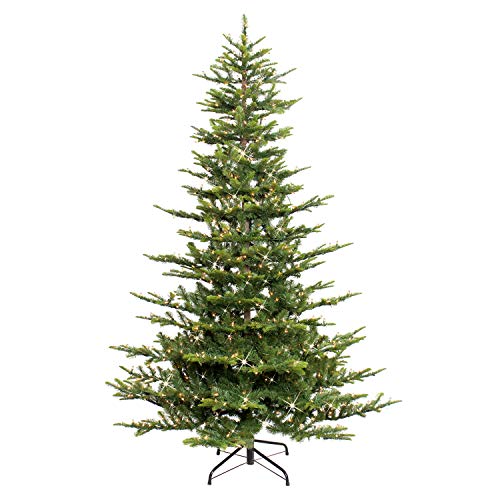
- Pre-strung with 700 continuous-glow clear lights
- Broad 58-inch profile fills spacious living areas
- Letter-coded sections simplify branch arrangement
- Includes folding metal stand with protective feet
- Hinged branches compress flat for off-season storage
Cons
- Wide 58-inch diameter requires substantial floor space
- Foliage is made entirely of PVC without PE needles
- Total weight over 32 pounds requires lifting effort
Pros
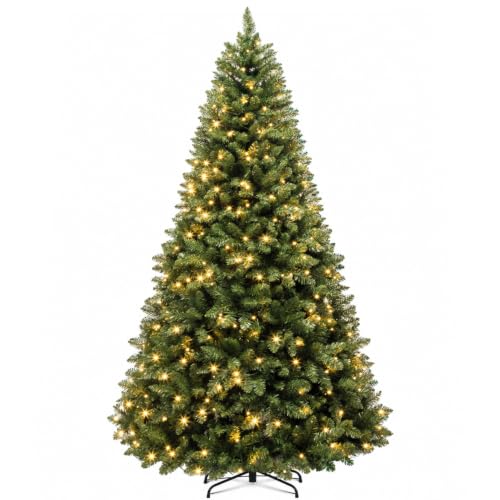
- Pre-strung with 300 warm white LEDs
- 1,213 branch tips for hanging decorations
- Hinged branches simplify assembly and seasonal storage
- Sturdy metal tree stand included

Pros
- Lights stay illuminated even if one bulb fails
- Labeled three-piece hinged branch design eases setup
- Sturdy folding metal stand included
- Constructed with flame-retardant PVC foliage
Cons
- Requires manual branch fluffing after assembly
- Wide 45-inch base needs ample floor clearance

Pros
- Versatile dual-color LEDs offer ten lighting modes
- PowerConnect design avoids messy cord connections between sections
- Full 59-inch base provides ample ornament hanging area
- Hinged branches simplify initial layout and end-of-season packing
- Sturdy metal base included in the package
Cons
- Wide 59-inch diameter requires significant open floor space
- Branch fluffing requires 45 to 60 minutes
- Heavy 45.2-pound overall weight can complicate lifting

Pros
- 1,000 branch tips provide dense coverage
- Hinged branches allow straightforward assembly
- Sturdy folding metal stand included
- Unlit branches allow custom lighting arrangements
- Lightweight frame at just 8 pounds
Cons
- Requires separate purchase and installation of lights
- Manual branch fluffing required for full appearance
Artificial Christmas Tree Buying Guide
PE vs. PVC branch tips
The single biggest realism factor is how the branch tips are made. PE (polyethylene) tips are injection-molded from real branch molds, so each needle cluster has shape and variation. PVC tips are flat cut strips that read as classic tinsel-era foliage from a distance. Most trees mix both: PE on the outer, visible tips and PVC deeper inside to add fullness at lower cost. The Treepool 7-foot tree on our list, for example, documents 2,272 mixed PE and PVC tips, which is the kind of concrete number worth comparing when two trees look similar in photos.
Tip count matters, but only relative to tree size. A thousand tips on a 6-foot tree (as Best Choice Products documents for its pine) gives dense coverage; the same count on a 9-foot tree would look sparse. When comparing, divide tips by height to get a rough density sense rather than chasing the biggest number.
Hinged vs. hook-on branches
Hinged branches fold down from the trunk, so setup is a matter of dropping each tier into place and fluffing. Hook-on branches ship loose and each one hooks into a bracket, which can add an hour or more to assembly on a large tree. Hinged construction costs more and weighs more, but for anyone who dreads setup day, it is the feature most likely to decide whether the tree actually gets put up in year five.
Pre-lit or unlit
Pre-lit trees arrive with lights strung and wired through the branches. The convenience is real: no annual untangling, and the light distribution is usually more even than hand-stringing. The trade-off is that the lights and the tree now share one lifespan. If a light section fails years in, repairs mean tracing wiring inside the foliage. Unlit trees (like the National Tree Company 6-foot and 7.5-foot unlit Dunhill Firs above) keep the two decisions separate: you choose your own lights, replace them freely, and the tree itself can last a decade.
If you go pre-lit, check the light count against tree height. Roughly one hundred lights per foot of height gives a full, festive look; well below that reads sparse once ornaments go on. The Hykolity 7-foot tree lists 300 warm white LEDs, which is on the lighter side and suits a minimalist style, while the Puleo 7.5-foot Aspen Fir lists 700 clear lights for a much brighter presence. Also confirm the bulb type: LEDs run cool, use little power, and typically outlast the tree, while older incandescent strings burn warmer and need more care.
Shape, diameter, and where it stands
Full-profile trees (50 to 60 inches in diameter at 7.5 feet, like the National Tree Company 7.5-foot unlit Dunhill Fir’s listed 59 inches) need a real corner or an open wall. Slim and pencil profiles (around 30 to 40 inches, like the Puleo 7.5-foot pencil tree’s listed 30-inch diameter) fit beside furniture, in entryways, and in apartments. Measure the floor space, not just the ceiling: a tree that fits vertically but blocks a walkway will annoy you every December.
Safety and storage
Look for flame-retardant or flame-resistant foliage in the specifications, and for pre-lit models, lights that are UL-listed. Keep any tree, lit or not, away from fireplaces, radiators, and candles. For storage, the original box works but degrades after a few seasons; a dedicated tree storage bag kept in a cool, dry place protects both branches and pre-strung wiring. Never store a pre-lit tree somewhere it will be crushed, since compressed light strings are the most common cause of dead sections the following year.
Matching the tree to the room
Think about where the tree lives before choosing a profile. A full 59-inch-diameter tree like the National Tree Company 7.5-foot unlit Dunhill Fir above wants a dedicated corner in a living room with space to walk around it. An open-plan room with the tree as a backdrop for gatherings rewards fullness. A bedroom, office, or apartment corner rewards a slim or pencil profile like the Puleo 7.5-foot pencil tree, whose listed 30-inch diameter tucks beside a bookshelf without blocking light. And for secondary spaces, a 6-foot tree on a sturdy table, or one of the tabletop flocked options on our sister guide, often looks more intentional than a cramped full-size tree.
Ceiling height sets the hard limit, but sight lines set the pleasant one. In a room where you sit close to the tree, a shorter, fuller tree at eye level feels grander than a tall sparse one. In a room with a vaulted ceiling or a two-story entryway, height is the whole point, and slim profiles keep a tall tree from overwhelming the floor plan.
Frequently Asked Questions
How long do artificial Christmas trees last?
Typically six to ten years with reasonable care. Hinges loosen, PVC fades, and pre-lit wiring ages, but a tree stored in a bag in a dry space and fluffed carefully each year stays presentable for a long time. If the tree still looks good but the lights fail on a pre-lit model, you can always string your own lights over it rather than replacing the whole tree.
Are more expensive artificial trees worth it?
Up to a point. The jump from a budget tree to a mid-range one usually buys molded PE tips, hinged branches, and better light strings, all visible differences. Beyond that you are paying for brand, extra tips, and fuller profiles, which matter most if the tree is the room’s centerpiece. For a secondary tree in a bedroom or office, a budget pick is perfectly sensible.
Do artificial trees look fake up close?
Close inspection will always reveal an artificial tree, but PE-tip trees look convincing at normal viewing distance, especially once decorated. Fluffing matters enormously: a well-shaped mid-range tree outperforms a neglected premium one. Plan on 30 to 60 minutes of branch shaping during setup, more for larger trees.
What size tree do I need for an 8-foot ceiling?
A 7 to 7.5-foot tree. Allow roughly six inches for the stand and six to twelve inches for a topper, so a 7.5-foot tree plus topper just clears an 8-foot ceiling. When in doubt, size down: a slightly smaller tree with room above it looks more elegant than one brushing the ceiling.
Prices and availability change through the holiday season, so use the product cards above for the current numbers. As an Amazon Associate, we earn from qualifying purchases made through links on this page.


